How to Build a Strong Personal Brand on Social Media
Primary Keyword: How to build a personal brand on social media
Secondary Keywords:
- Personal branding on social media
- How to grow a personal brand online
- Social media personal branding strategy
- Personal branding tips for social media
- How to create a personal brand online
Search Intent: Informational + Commercial Investigation
1. Introduction: Why Personal Branding Matters on Social Media (80–100 words)
Start with a direct answer to the reader’s problem: social media is no longer only a place for entertainment; it can help professionals, creators, freelancers, students, entrepreneurs, and business owners build credibility.
Briefly explain what personal branding means and why having a recognizable online identity matters.
SEO/GEO focus: Naturally introduce the primary keyword: “how to build a personal brand on social media.”
Include a concise answer such as:
A strong personal brand on social media is built by consistently communicating who you are, what you know, and the value you offer to a specific audience.
This type of direct definition can help search engines and AI-powered search tools understand the page quickly.
2. What Is Personal Branding on Social Media? (90–100 words)
Explain personal branding on social media in simple language.
Cover:
- Your expertise and skills
- Your personality and values
- Your visual identity
- Your communication style
- The type of audience you want to attract
Explain that personal branding is more than having a professional profile photo or attractive Instagram feed. It is about creating a consistent perception of you across platforms such as Instagram, LinkedIn, YouTube, Facebook, and X.
GEO opportunity: Use a clear definition that can stand alone as an answer to a search query.
3. How to Build a Personal Brand on Social Media: 5 Essential Steps (250–280 words)
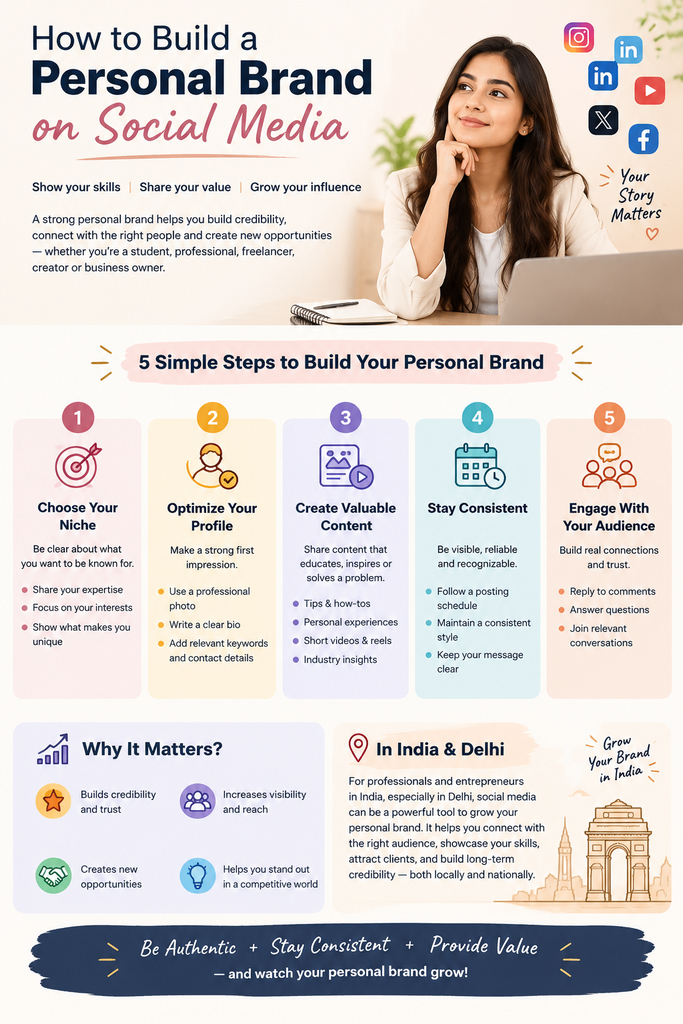
This should be the main section of the article and directly answer the primary search intent.
Step 1: Define Your Niche
Explain why choosing a specific area of expertise helps people understand what you offer.
Examples:
- Digital marketing
- Fitness
- Technology
- Finance
- Fashion
- Travel
- Content writing
Step 2: Identify Your Target Audience
Explain how creators should understand their audience’s needs, problems, interests, and location.
For example, a digital marketing consultant targeting small businesses in Delhi, Mumbai, or Bengaluru can create content around local business marketing challenges.
GEO focus: Include relevant geographic terms naturally when appropriate rather than forcing locations into every paragraph.
Step 3: Create a Consistent Profile
Discuss:
- Professional profile image
- Clear bio
- Relevant username
- Consistent visual style
- Contact information
- Link to portfolio or website
Step 4: Create Valuable Content Consistently
Explain the importance of educational, entertaining, inspirational, and problem-solving content.
Mention formats such as:
- Reels
- Carousels
- Short videos
- LinkedIn posts
- Stories
- Long-form posts
Step 5: Engage With Your Audience
Explain why replying to comments, answering questions, joining conversations, and building relationships can strengthen credibility.
4. How to Grow a Personal Brand Online (100–120 words)
Use the secondary keyword “how to grow a personal brand online.”
Discuss practical growth methods:
- Follow a consistent posting schedule
- Share original insights
- Use relevant keywords and hashtags
- Collaborate with other creators
- Participate in industry conversations
- Repurpose content across platforms
- Analyze engagement and improve content
Emphasize that sustainable growth is based on trust and consistency, not simply follower count.
GEO focus: Include actionable, easily extractable recommendations in bullet points or short paragraphs.
5. Social Media Personal Branding Strategy: What Should You Post? (80–100 words)
Explain how to develop a simple content strategy.
Use the 3–4 content pillar method, such as:
- Educational: Teach something useful.
- Personal: Share experiences and lessons.
- Authority: Demonstrate expertise.
- Engagement: Ask questions or start conversations.
Mention that content should match the platform and audience. For example, LinkedIn may work well for professional insights, while Instagram and YouTube can be useful for visual and video-based personal branding.
6. Personal Branding Tips for Social Media (70–80 words)
Add a quick actionable section using the keyword “personal branding tips for social media.”
Suggested tips:
- Be authentic rather than copying competitors.
- Maintain a consistent tone.
- Use a recognizable profile identity.
- Focus on audience value.
- Share opinions backed by experience.
- Avoid posting unrelated content too frequently.
- Track what content performs best.
Keep this section highly scannable.
7. How to Create a Personal Brand Online: Common Mistakes to Avoid (50–60 words)
Briefly address mistakes such as:
- Trying to appeal to everyone
- Inconsistent posting
- Copying other creators
- Focusing only on followers
- Having unclear messaging
- Ignoring audience engagement
This section captures additional long-tail search intent around “how to create a personal brand online.”
8. FAQ: Personal Branding on Social Media (80–100 words)
Add 3–4 short questions with direct answers.
What is the best social media platform for personal branding?
The best platform depends on your audience, industry, and content format.
How long does it take to build a personal brand?
Building recognition usually takes consistent effort over time rather than a few viral posts.
Can beginners build a personal brand?
Yes. Beginners can start by sharing useful knowledge, experiences, projects, and lessons within a specific niche.
How often should I post?
Choose a schedule you can maintain consistently while prioritizing content quality.
GEO focus: FAQ-style questions and concise answers make the content easier for search engines and AI systems to interpret.
9. Conclusion: Start Building Your Personal Brand Today (50–60 words)
End with a concise summary.
Reinforce that building a personal brand requires clarity, consistency, valuable content, audience engagement, and authenticity.
Include the primary keyword naturally one final time and encourage readers to start with one platform and one clear area of expertise.
SEO + GEO Optimization Checklist
- Use the primary keyword in the title, introduction, one H2, and conclusion.
- Use secondary keywords naturally throughout the article.
- Add descriptive H2/H3 headings.
- Include direct answers to important questions.
- Use short paragraphs and bullet points for AI readability.
- Add FAQ-style content.
- Include relevant local terms such as India, Delhi, Mumbai, Bengaluru, only where they genuinely fit the audience or example.
- Avoid keyword stuffing.
- Use related terms such as online reputation, social media strategy, content creation, audience engagement, digital presence, and brand visibility.
- Keep information factual, practical, and easy for both readers and AI search systems to understand.